
12 Self-Publishing Contract Clauses to Read Twice
The contract lands in your inbox, the cover looks promising, the publishing plan sounds professional, and somebody is waiting for your signature.
That is exactly when you should slow down.
Most bad publishing decisions do not begin with a sentence that says, “Give us control of your book.” They begin with ordinary-looking language about rights, royalties, files, distribution, renewals, or account management.
The most important self publishing contract red flags appear when the agreement gives a company more control than it needs to perform the services you are actually buying.
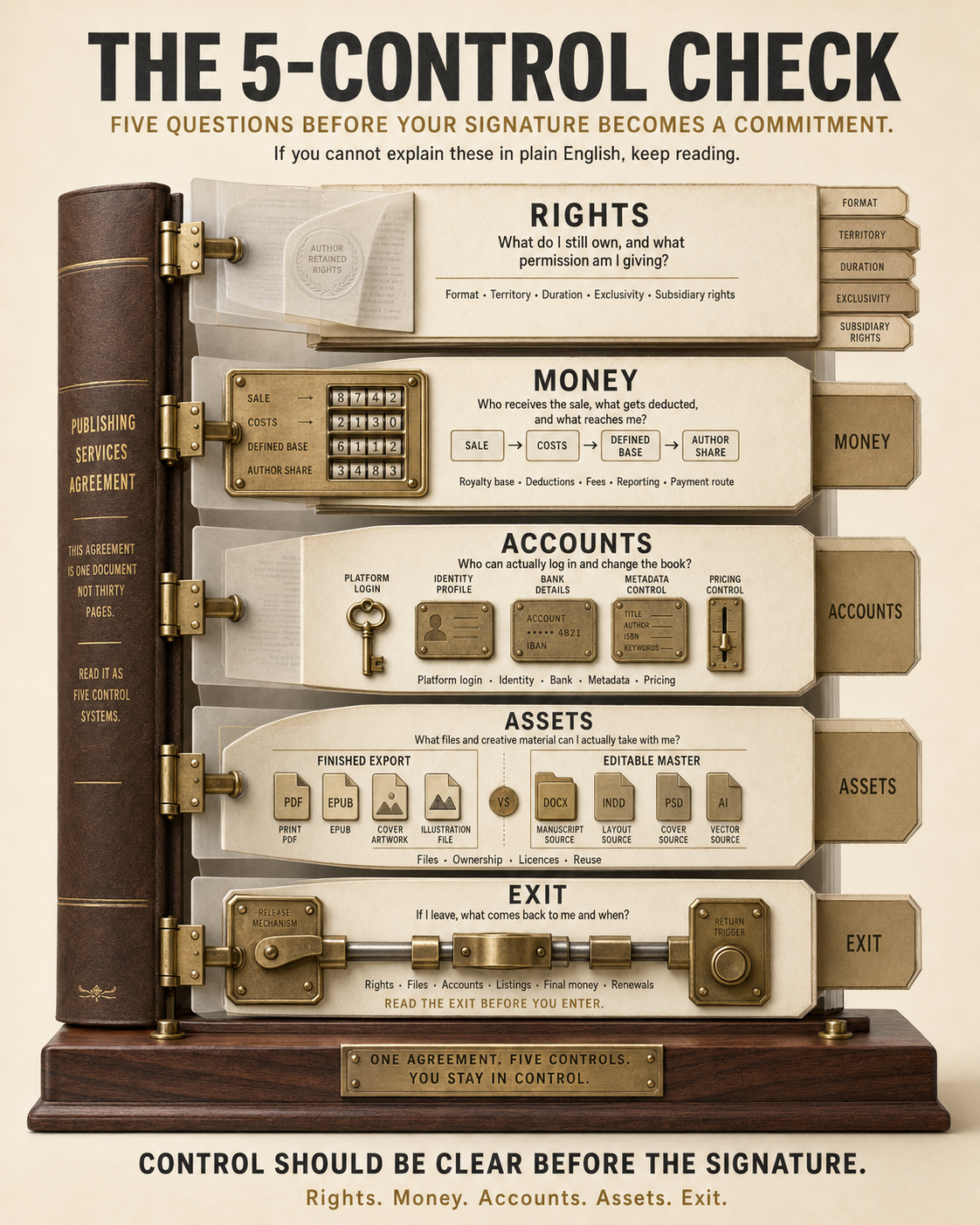
Before signing, you should be able to answer five plain-English questions:
Who controls your rights, your money, your publishing accounts, your book assets, and your exit?
If the contract cannot answer those clearly, it is not ready for your signature.
Montlake Publishers takes the same practical view of self-publishing: start with what the book actually needs, define responsibilities clearly, and understand what remains under the author's control before production moves forward.
Important: This guide offers general publishing information, not legal advice. Contract rights and obligations depend on the exact wording and the law that applies to your agreement. Get advice from a qualified publishing attorney when significant rights, money, or liability are involved.
Key Takeaways
Keep rights and service scope separate. Paying someone to edit, design, format, or publish a book does not automatically mean they need ownership of it.
Follow the money past the royalty percentage. Definitions, deductions, reporting, and payment routing matter more than a headline number.
Protect the things you may need later. Publishing accounts, ISBN information, source files, artwork rights, and metadata can affect your ability to move providers.
Read the exit before you enter. Cancellation means little if rights, files, listings, or money remain trapped afterward.
Which Self Publishing Contract Red Flags Matter Most?
The clauses worth the closest attention are the ones controlling ownership, publication rights, royalties, fees, deliverables, publishing accounts, ISBN and metadata, production files, marketing obligations, termination, future restrictions, liability, and AI use. A clause is not automatically unfair because it is complex, but unclear control or one-sided obligations deserve questions before you sign.
One distinction matters from the start.
Traditional publishers, hybrid publishers, and self-publishing service companies operate differently.
A traditional publisher normally finances publication and licenses publishing rights from the author.
A hybrid publisher may combine author investment with publisher services and a royalty arrangement.
A self-publishing service provider is generally being paid to perform specific work such as editing, design, formatting, publishing setup, illustration, or distribution assistance.
That means an upfront fee is not automatically a red flag.
The real warning sign is a contract that behaves differently from the business model you thought you were buying.
Use the Montlake 5-Control Check Before Reading Every Clause
Legal wording becomes easier to understand when you stop reading the contract as one long document and start tracking control.
| Control | Question you need answered |
|---|---|
| Rights | Who owns the work, and what rights are you giving the company? |
| Money | Who receives book revenue, what can be deducted, and when are you paid? |
| Accounts | Who controls KDP, distributor, payment, ISBN, and publishing accounts? |
| Assets | Who owns or can reuse the manuscript, cover, illustrations, layouts, and source files? |
| Exit | How do you leave, recover anything granted, receive files, remove listings, and settle final payments? |
Keep those five words beside you while reading:
Rights. Money. Accounts. Assets. Exit.
They expose problems that a package brochure may never mention.
12 Self-Publishing Contract Clauses to Read Twice
1. Copyright Ownership That Quietly Changes Hands
Start with the sentence that answers the biggest ownership question:
Who owns the copyright after you sign?
Paying a company to edit or prepare your manuscript does not, by itself, mean that company needs to own the underlying book.
The U.S. Copyright Office explains that copyright includes a bundle of exclusive rights that can be transferred or licensed. Ownership and permission are therefore not the same thing.
Watch for wording such as:
“assign”
“transfer”
“all right, title, and interest”
“work made for hire”
“publisher shall own”
Context matters, and some commissioned work can involve different ownership arrangements. Do not assume a label has the legal effect somebody says it does.
Read twice when:
One part of the agreement says the author retains ownership while another appears to transfer broader copyright interests.
Do this: Get the ownership position stated plainly and consistently.
Not that: Stop reading as soon as you see the words “author retains copyright.”
2. Rights and Exclusivity That Go Further Than the Job
Keeping copyright does not solve everything.
The next section may give the company an exclusive licence to publish, distribute, reproduce, translate, adapt, sublicense, record, or otherwise use the book.
Some permission may be necessary.
The question is how much.
If you are paying for ebook and paperback production, why does the agreement also need film, television, merchandise, translation, audiobook, or sequel rights?
Check four things:
format
territory
duration
exclusivity
Also inspect subsidiary and derivative rights.
The Authors Guild's current hybrid-publishing contract guidance recommends limiting broad rights grants and reserving rights a publisher does not need or is not positioned to use.
A rights clause should fit the actual work being performed.
3. Royalty Language That Makes a Great Percentage Meaningless
“70% royalty” sounds simple.
It rarely is.
You need to know 70% of what.
Look for terms such as:
list price
gross receipts
net receipts
net revenue
net profit
printing deductions
distributor fees
taxes
discounts
refunds
reserves
marketing costs
The calculation underneath the percentage controls what reaches you.
Current Authors Guild guidance published in July 2026 notes that author-funded hybrid arrangements can involve upfront fees ranging from a couple thousand dollars to tens of thousands of dollars.
That is why you cannot judge a deal from one price or one royalty number.
You need the whole equation.
Ask for a worked example
If the book sells for a given retail price:
What does the retailer keep?
What other costs come out?
What amount remains?
Which amount is your percentage applied to?
Who receives the money first?
If somebody selling the contract cannot explain that calculation clearly, do not expect the royalty statement to make it easier later.
4. Fees That Continue After the “Total” Package Price
Your source material correctly identifies vague pricing and hidden costs as a major warning sign.
The stronger version of that rule is:
Large fees are not automatically bad. Undefined fees are.
Publishing work can legitimately involve editing, illustration, design, formatting, print costs, distribution, production, and specialist services.
Your agreement should tell you which of those are included.
Read for:
additional editing charges
extra revision charges
annual fees
account-management fees
distribution fees
storage or fulfilment costs
rush charges
additional-format fees
mandatory author-copy purchases
renewal charges
third-party expenses
marketing spend
Optional work should look optional.
Additional work should have a trigger.
A fixed package should not become an open-ended invoice.
5. Deliverables That Sound Better Than They Read
“Professional editing.”
“Worldwide distribution.”
“Complete book marketing.”
“Premium cover design.”
Those phrases sell services.
They do not define them.
Contracts need nouns you can count and actions you can verify.
Editing
Which type?
Developmental editing, line editing, copyediting, proofreading, or a combination?
Design
How many concepts or revision stages?
Which final formats?
Publishing
Which platforms?
Who uploads the files?
Who approves metadata and pricing?
Marketing
Which specific actions are included?
Who pays any external advertising costs?
Revisions
What counts as a revision?
What counts as new work?
This is where a provider's promises should become a scope of work.
If something influenced your decision to buy, look for it in writing.
6. KDP and Distributor Accounts Controlled by the Provider
This red flag rarely gets enough attention.
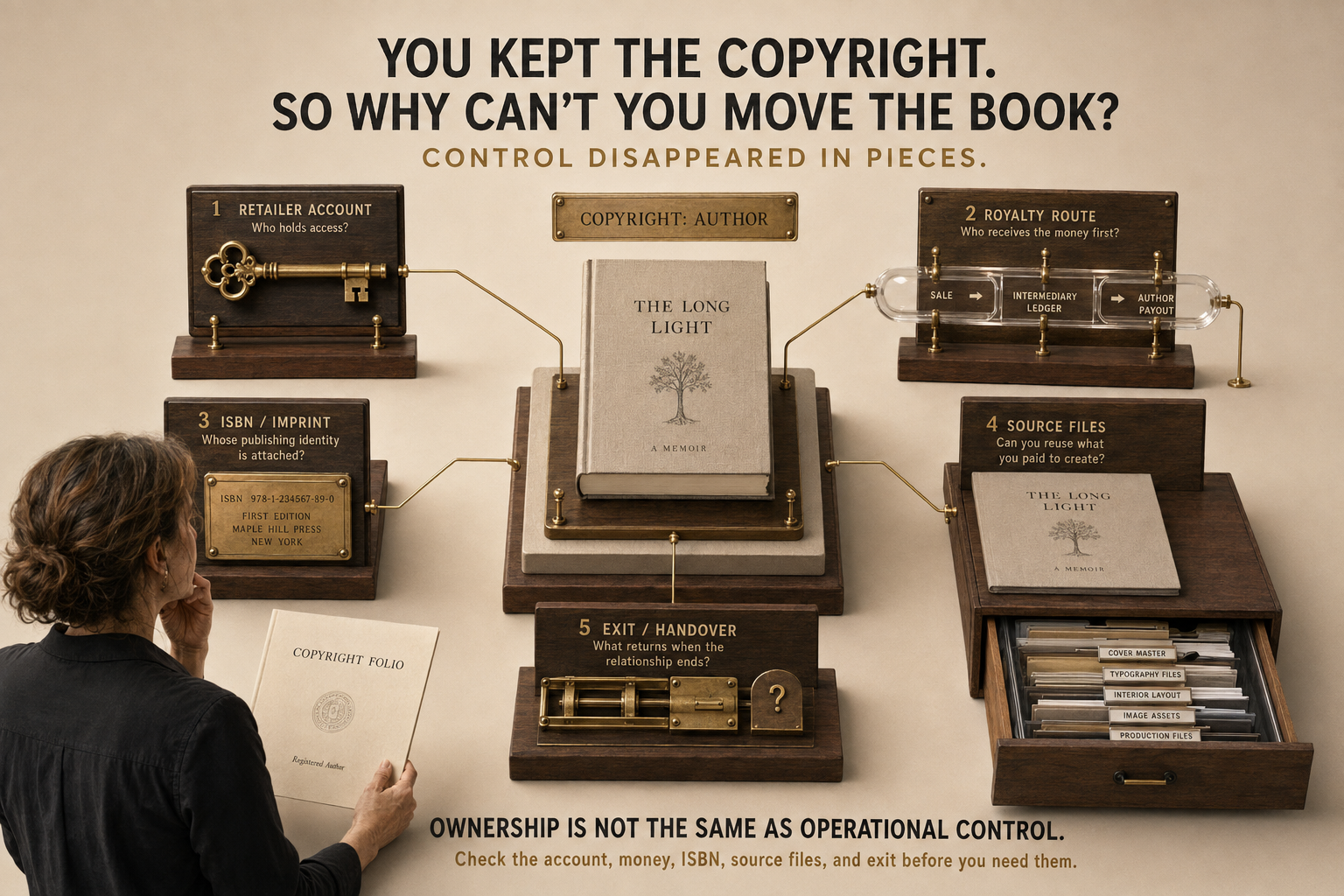
You can own copyright and still lose practical control of the book.
Amazon's official Kindle Direct Publishing Terms and Conditions make the account holder responsible for maintaining accurate account information and safeguarding account credentials.
That makes account ownership a serious publishing decision.
Before a company sets anything up, ask:
Whose email creates the KDP account?
Who holds the login?
Whose identity information sits on the account?
Whose bank details receive payments?
Who can change metadata or pricing?
What happens to account access when the service ends?
A contractor may help you publish.
That does not mean the contractor should become the only route into your publishing business.
If you need to call somebody else every time you want to change your own book, that is not much independence.
7. ISBN, Imprint, Metadata, and Pricing Control Left Undefined
Small publishing details have long memories.
An ISBN affects how an edition is identified.
The imprint can affect who appears as publisher of record.
Metadata affects how retailers identify and display the book.
Pricing affects your commercial strategy.
The agreement should clarify responsibility for:
ISBN
imprint
title and subtitle
author name
book description
categories
keywords
territory settings
retail price
future metadata updates
None of those questions needs drama.
They need answers.
Authors often discover these dependencies only when they want to change something after publication.
By then, the original sales call is ancient history.
The contract is what remains.
8. Source Files and Creative Assets You Paid for but Cannot Reuse
Your source material makes one especially useful point: access to original source files matters.
Keep it.
A finished book can involve far more intellectual property than the text.
You may have:
an edited manuscript
print-ready interior files
EPUB files
cover artwork
layered design files
illustrations
typography licences
stock imagery
audiobook recordings
formatting templates
Paying for an asset does not always answer every ownership or reuse question.
The agreement should identify:
what you receive,
which files are editable,
who owns each creative asset,
which licences apply,
what you may reuse after the project ends.
The republishing test
Imagine the company disappears next month.
Could you take your manuscript and existing production assets to another qualified provider and republish the book without rebuilding everything?
If not, find out why before you sign.
9. Distribution or Marketing Promises With No Deliverable Behind Them
“Available worldwide” and “distributed globally” can sound bigger than they are.
Availability is not the same thing as bookstore placement.
Distribution is not the same thing as demand.
Marketing support is not the same thing as guaranteed sales.
Your supplied source warns about companies promising bestseller status or instant success. That warning is worth keeping, but the contract-level lesson is more useful:
Do not buy an outcome when the agreement only specifies activity.
No publisher or service provider can control every factor that determines sales.
Read the contract for what the company will actually do.
For distribution:
Which platforms or networks?
Who supplies the files?
Who controls pricing?
Who receives sales reporting?
For marketing:
Which tasks?
Which materials?
Which campaigns?
Which expenses are included?
Which responsibilities remain with the author?
A promise you cannot identify in the scope is not much of a contractual promise.
10. Termination, Renewal, and Rights Reversion That Do Not Create a Real Exit
Read the breakup clause while everybody is still getting along.
You need to know:
how you terminate,
how much notice is required,
what fees remain payable,
whether refunds apply,
when distribution stops,
when accounts or files are handed over,
what happens to royalties already earned,
whether licences or rights end,
whether the agreement renews automatically.
Rights reversion becomes especially important when publishing rights have been granted.
The Authors Guild's 2026 hybrid-publishing checklist specifically recommends clear termination language and clear return of granted rights.
Do not confuse “you may cancel” with “you regain control.”
Those are two different promises.
11. Future-Book, Non-Compete, Indemnity, or One-Sided Risk Clauses
The agreement is supposed to cover this project.
Read carefully when it begins reaching into the next one.
Watch for language involving:
your next manuscript
first refusal
option rights
competing books
sequels
future works
cross-collateralization
A paid publishing-service relationship should not quietly become a claim on your future writing without a clear reason.
Then read the liability section.
Warranties may ask you to confirm that you have the right to provide the manuscript and that you have not knowingly infringed somebody else's rights.
That is different from agreeing to unlimited responsibility for every allegation, legal expense, or loss that might ever arise.
Look at the agreement from both directions:
What happens when the author breaches it?
Then:
What happens when the provider breaches it?
If one side has detailed remedies and the other has almost none, that imbalance deserves attention from a lawyer.
12. AI Rights Hidden Inside General Technology Language
This is the clause a 2026 article cannot treat as an afterthought.
Contracts written before generative AI became a publishing issue may contain broad references to digital technologies, derivative uses, future formats, data processing, or sublicensing.
Do not assume those words answer modern AI questions.
Ask directly:
Can the manuscript be uploaded to consumer-facing AI systems?
Can the work be used for AI training?
Can the provider license AI-training rights?
Can AI generate summaries from the manuscript?
Can AI create audiobook narration?
Can AI translate the book?
Can AI generate illustrations or cover assets?
Is written author permission required?
The Authors Guild's current AI model contract guidance recommends dealing with AI rights expressly rather than assuming they are included in a general rights grant.
Authors Guild CEO Mary Rasenberger summarized the issue well:
“There is a great need for clarity in the industry around what rights are implicated by the different types of AI uses.”
The April 2026 Authors Guild update also addresses AI training, audiobook narration, translation, manuscript uploads, and other emerging uses.
That is the right standard for your own reading:
Do not guess what an AI clause means. Make the permission explicit.
What Do Authors Most Often Get Wrong Before Signing?
Bad publishing contracts are not always full of obviously outrageous language.
More often, authors miss ordinary details because they are focused on finally getting the book published.
Mistake 1: “They Said I Keep Copyright, So I Am Safe”
Copyright matters.
So do your KDP account, source files, metadata, ISBN, payment flow, and termination rights.
Do this: Check legal ownership and operational control separately.
Not that: Treat copyright as the only form of control.
Mistake 2: Reading the Package Instead of the Agreement
Marketing copy describes the offer.
The contract governs the relationship.
Anything important enough to influence your decision should have a clear written counterpart.
Mistake 3: Comparing Only the Price
The cheapest package can be poor value.
The expensive package can also be poor value.
Compare:
price + scope + ownership + control + exit
Mistake 4: Waiting Until Something Goes Wrong to Ask Who Owns the Files
The easiest time to discuss file ownership is before the designer starts.
The worst time is after the relationship ends.
What Would This Look Like in a Real Publishing Situation?
Consider a simple illustrative example.
You pay a company to edit your manuscript, design the cover, format the interior, and publish the book.
The copyright remains in your name.
So far, good.
Months later, you decide to manage the book independently.
Then you learn:
the retailer account belongs to the provider,
royalty payments arrive there first,
the ISBN was supplied under its imprint,
you received a flattened cover file but not the editable artwork,
distribution cancellation has no defined handover process,
the marketing promise was never itemized.
No single clause said, “The author loses the book.”
Control disappeared in pieces.
That is why the 5-Control Check works better than hunting only for dramatic legal language.
How Should You Review a Self-Publishing Contract Before Signing?
Step 1: Identify What Kind of Deal You Are Actually Buying
Write one sentence:
“I am paying this company to ______.”
Then compare that sentence with the rights and financial clauses.
If you think you are buying services but the agreement reads more like a publishing-rights acquisition, find out why.
Step 2: Highlight Every Control Clause
Use five labels:
RightsMoneyAccountsAssetsExit
Mark every clause that affects one.
Step 3: Turn the Sales Proposal Into a Deliverables Checklist
Write down everything promised.
Then find each item in the agreement or incorporated project scope.
Missing item?
Ask.
Step 4: Trace the Money From Reader to Author
Do not stop at the royalty rate.
Identify:
sale → retailer/distributor → deductions → provider → author.
Know who touches the money and why.
Step 5: Picture the Relationship Ending
Ask yourself:
If I leave next year, what do I take with me?
You should know what happens to rights, files, accounts, listings, metadata, money, and unfinished work.
Step 6: Get Legal Review When the Contract Goes Beyond Routine Service Terms
Publishing consultants can explain what their own company will deliver.
They should not replace independent legal advice about a complex rights transfer, indemnity obligation, exclusivity restriction, or dispute clause.
How Does Montlake Publishers Fit Into This Decision?
Good self-publishing support should remove confusion from production, not create more confusion about ownership.
Montlake Publishers describes itself as an independent author-services company supporting authors through writing, editing, design, publishing, printing, and related stages.
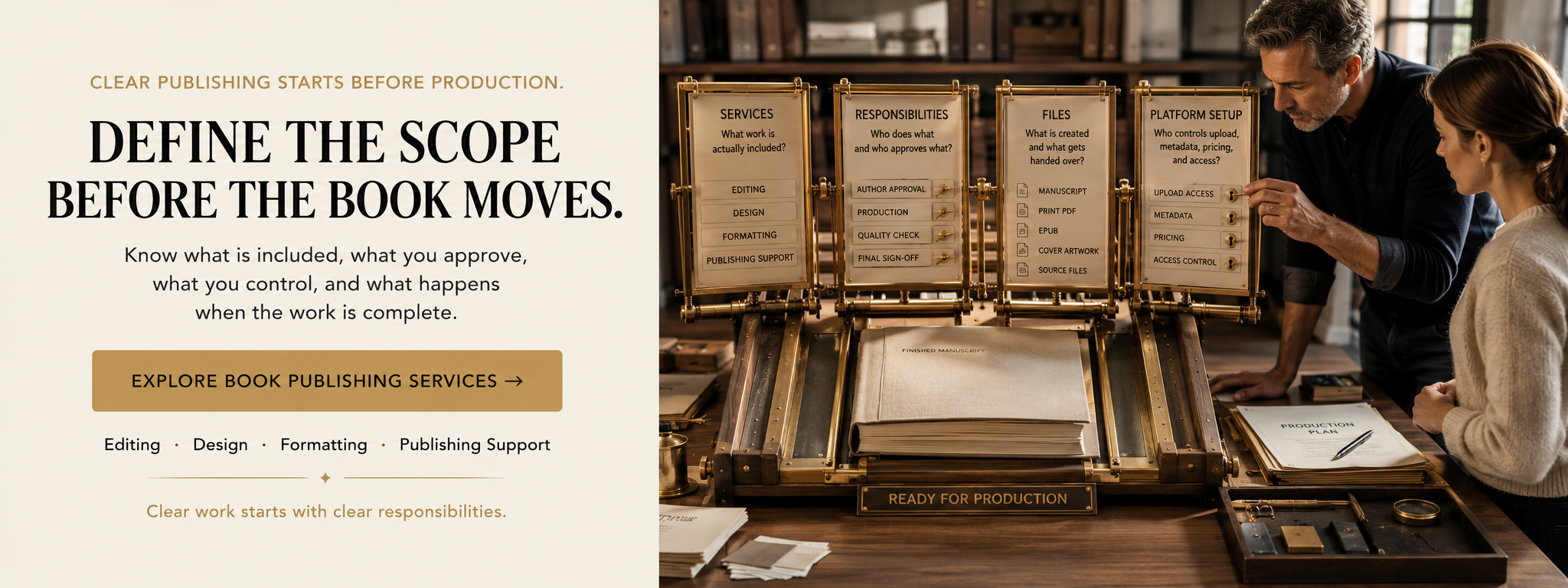
Its book publishing services are therefore most useful when the project scope is clear before work begins: manuscript condition, formats, production stages, responsibilities, files, platform setup, and the support the author actually wants.
Readers can also review Montlake's published Terms & Conditions before entering a service relationship.
The right question is not:
“Which package gives me the most?”
Ask:
“Which services does my book need, and what will I still control when those services are complete?”
That question protects both sides.
Final Thoughts: Your Signature Should Not Create New Questions
Finishing a book is emotional.
Signing the agreement needs to be practical.
Read past the polished package description and find the clauses that decide what happens after payment, after publication, and after the working relationship ends.
The most useful way to spot self publishing contract red flags is to keep returning to five things:
Rights. Money. Accounts. Assets. Exit.
Know who controls each one.
Then decide whether the agreement supports the kind of independent publishing relationship you actually want.
Know What You Still Control Before You Sign
You should leave a publishing agreement knowing exactly what the company will do and what remains yours.
If you need professional help moving a manuscript from finished draft to publication, review Montlake Publishers' book publishing services and define the project scope before committing to work your book does not need.
Know the service. Know the terms. Know what stays under your control.
Frequently Asked Questions
What should a self publishing contract include?
A self-publishing contract should clearly describe the services, payment terms, deliverables, revisions, ownership, necessary licences, publishing-account responsibilities, production files, cancellation procedure, and final handover. Distribution or royalty provisions should also explain how money and reporting work when the provider handles either.
Can a self publishing company own my copyright?
Copyright ownership depends on the agreement, but purchasing self-publishing services does not automatically require transferring the copyright in your manuscript. Read assignment, licence, and work-made-for-hire language carefully, and get independent legal advice before agreeing to an ownership transfer you do not fully understand.
Should I give a self publishing company exclusive rights?
Only grant exclusivity after you understand which rights it covers, why the provider needs them, where they apply, how long they last, and how they end. A broad exclusive grant may restrict other publishing options even when the service you purchased was much narrower.
Who should control my Amazon KDP account?
The author or publishing business should understand who owns and controls the KDP account used for the book. Amazon places account-security responsibilities on the account holder, so login credentials, identity details, payment information, and long-term access should never be treated as minor administrative details.
What does net receipts mean in a publishing contract?
Net receipts generally refers to money received after specified deductions, but your contract's exact definition matters. Read which discounts, taxes, printing charges, returns, distribution costs, fees, or other expenses may come out before the author's share is calculated.
Can I cancel a self publishing contract?
Your ability to cancel depends on the termination clause. Review notice requirements, outstanding payments, refund rules, unfinished work, retailer listings, source-file delivery, account handover, and the treatment of any rights or licences that continue after cancellation.
What happens if my publishing service company closes?
What happens depends on who controls the rights, retailer accounts, ISBN information, source files, royalties, and distribution relationships. Keeping your own records and copies reduces dependency. Complex insolvency or rights problems should be discussed with a qualified lawyer in the relevant jurisdiction.
Should a self publishing company receive part of my royalties?
That depends on the business model. Fee-based self-publishing services and hybrid publishing arrangements can structure compensation differently. The important point is that the agreement clearly explains whether revenue sharing applies, how it is calculated, what deductions occur, and what service or right justifies the share.
Can a publisher or service provider use my manuscript for AI training?
Only assume AI use is permitted when the agreement actually says so. Current Authors Guild guidance recommends dealing with AI training and related rights expressly. Authors should also review permissions involving manuscript uploads, automated summaries, audiobook narration, translation, and AI-generated artwork.
Should I have a lawyer review a self publishing agreement?
Legal review becomes especially useful when the agreement contains broad rights grants, exclusivity, substantial financial obligations, future-book restrictions, complex royalty definitions, indemnification, or language you simply cannot explain in plain English. Publishing-industry experience is helpful because the terminology and business models differ from ordinary service contracts.