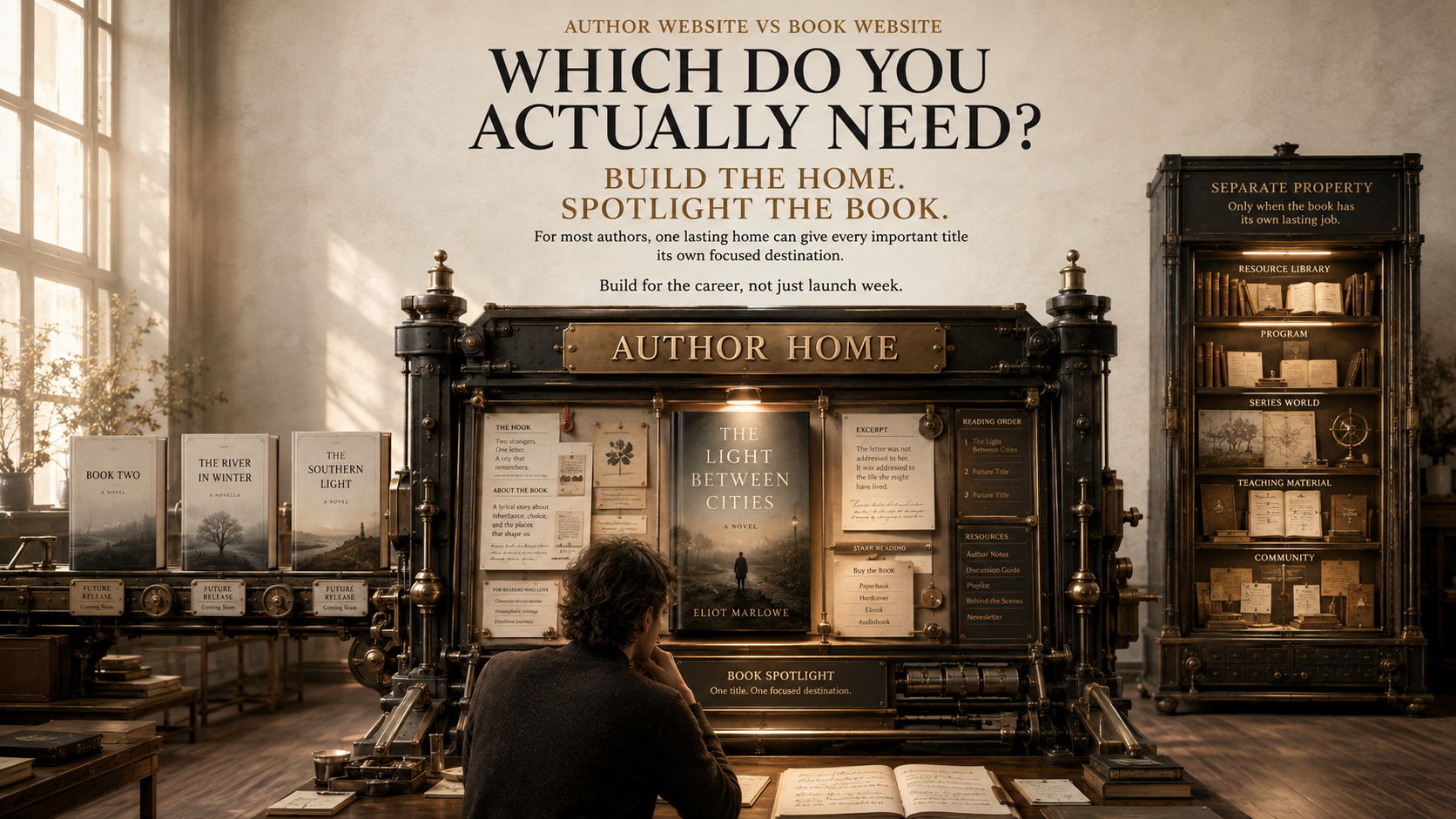
Which Do You Actually Need: Author Website vs Book Website?
Your book is almost ready.
The cover is coming together. Publication is getting real. Then one small question somehow turns into an entire afternoon of tabs:
Should the website use your name or your book title?
Do you need an author website, a website just for the book, or both?
And if you build around this book now, what happens when the next one arrives?
That is the real problem behind author website vs book website. You are not simply choosing between two types of web design. You are deciding what deserves to become the long-term home of your writing career and what only needs a focused place to do one job well.
For most authors, two complete websites are unnecessary.
The smarter setup is usually one long-term author home with a strong page for each book. A separate book website earns its place only when that title has a lasting purpose, audience, or body of resources that genuinely needs its own space.
That thinking also fits the way Montlake Publishers approaches publishing support: start with what the project actually needs next, rather than adding everything simply because it is available.
Key Takeaways
Planning a long-term writing career? Build around the author or pen name and give every important title its own book page.
Promoting one release or preorder? A focused book landing page may do the job without requiring another full website.
Building something larger around the title? A separate book website can make sense when the book has its own program, resource library, series identity, or distinct audience.
Maintenance matters. A smaller website that stays current is more useful than several impressive-looking sites you no longer have time to update.
So, Which Do You Need in Author Website vs Book Website?
For most writers who plan to publish more work, an author website should be the main home, with a dedicated page for each book. Choose a separate book website when the title needs an independent, long-term destination for a distinct audience, campaign, program, series, or collection of resources.
Here is the difference at a glance:
| Decision Point | Author Website | Book Page / Landing Page | Separate Book Website |
|---|---|---|---|
| Main focus | You and your body of work | One title and one next action | One title or series as its own brand |
| Best lifespan | Long term | Permanent or campaign-based | Long term when the book has its own purpose |
| Future releases | Easy to add | Create another book page | May require another site or restructure |
| Reader journey | Discover you, your books, and what comes next | Understand one book and act | Go deeper into one book or series |
| Maintenance | One central property | Usually low | Highest |
| Best fit | Career authors, several titles, series, experts | Launches, preorders, new releases | Large series, educational properties, programs, distinct audiences |
The number of books matters, but it should not be the only deciding factor.
One book can justify an author website.
Several books can still work perfectly well under one author domain.
The deciding question is what job the website needs to keep doing after the current launch is over.
Why Does an Author Website Usually Make More Sense Long Term?
Your current book has a publication cycle.
Your name does not.
Readers may first meet you through one title, but that does not mean their interest ends on that book's final page. They may want another book, the correct series order, news about what you are writing next, an interview, event details, background about you, or a way to hear about future releases.
That is where an author website becomes more useful than a site built around one product.
Author website designer Pauline Wiles gives the long-term argument in one clean sentence:
“Brand you, the author, not the book.”
Her current guidance also points out that a book-title domain does not necessarily need to become a second full website. It can simply direct visitors to the relevant book page within the main author site.
Read Pauline Wiles’ author-vs-book domain guidance
Your Author Identity Can Survive the Current Release
Suppose your debut is a historical mystery.
Two years later, you publish the sequel.
Then a novella.
Then another series in the same broad genre.
Building your main site around the first book title would eventually create an awkward question: does everything still belong there?
Building around your author or pen name avoids that problem. The books can change while the main identity stays recognizable.
Every Book Can Still Have Its Own Space
Choosing an author website does not mean cramming every title onto one generic Books page.
Give important titles dedicated pages.
Each book page can carry:
the cover
title and subtitle
a short hook
book description
format information
purchase links
reviews or endorsements you are allowed to use
an excerpt or sample
reading-order information
related resources
relevant media or event material
Readers arriving because of one title can land directly on that title instead of being dropped onto a general homepage.
This is the part many “author site vs book site” comparisons miss.
One author website can still create a highly focused experience for every individual book.
Readers Do Use Author Websites to Discover Books
Fresh 2026 reader research supports keeping author-owned web pages in the reader journey.
The Written Word Media 2026 Reader Survey found that 30% of respondents named author websites as a way they discover new books.
Written Word Media also makes an important limitation clear: its respondents skew toward active digital readers, so the figure should not be treated as representative of every reader.
That caveat makes the finding more useful, not less. It tells us author websites are a real discovery route for an engaged reader segment without pretending a website is where every book sale begins.
What Does a Book Website Do Better?
Focus.
A book-centered destination can strip away everything unrelated to the title and make one decision easier.
That can be useful during:
a preorder campaign
a new-book launch
an event campaign
a limited edition
a crowdfunding project
a bulk-order push
an educational rollout
a major publicity campaign
a series launch
The important distinction is that a book website and a book landing page are not necessarily the same thing.
Book Landing Page
Think short, focused, and action-driven.
A landing page might contain:
Book cover → hook → description → proof → sample → purchase options → next action
Its purpose might be to get the visitor to:
Preorder
Buy
Request A Bulk Order
Download An Excerpt
Join A Book-Specific List
Register For An Event
You do not necessarily need another full navigation system, several content sections, a blog, or a large website behind it.
Full Book Website
Think broader and longer lasting.
A separate book website becomes more reasonable when visitors need substantially more than a sales page.
Perhaps the book now supports:
Teaching Material
Worksheets
Book-Club Resources
Research Material
Classroom Guides
An Expanding Fictional World
Events
Licensing Information
A Community
A Program Based On The Book
A Substantial Multimedia Or Resource Library
Now the title has work to do beyond selling itself.
That is when another website begins to earn the time it requires.
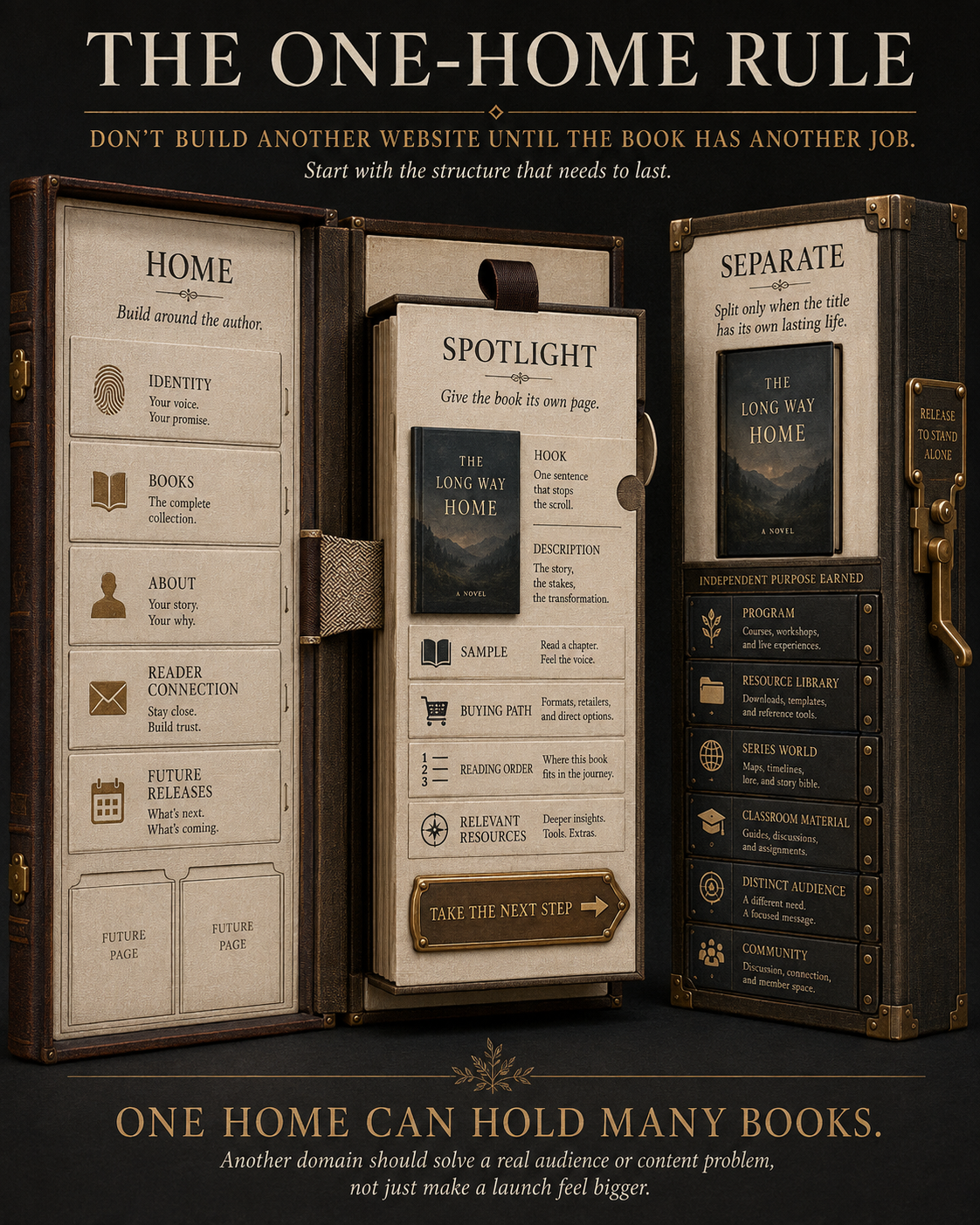
Use the One-Home Rule Before You Build Anything
Here is the simplest decision rule in this article:
Home: Build Around the Author
Use your author or pen-name website as the lasting home for your writing career.
Spotlight: Give the Book Its Own Page
Let each important title have a focused destination with its own message, design cues, purchase path, and supporting material.
Separate: Split Only When the Book Has Its Own Life
Create another full website only when the title serves a clearly separate audience or supports enough independent material to justify another property.
This avoids the worst of both extremes.
You do not bury an important release inside a generic author page.
You also do not create five separate websites simply because you eventually publish five books.
When Does a Separate Book Website Actually Make Sense?
Several situations can justify the additional work.
The Book Has Become a Program or Business
Nonfiction books sometimes develop into something larger.
The title may support training, workshops, corporate programs, educational material, assessments, certifications, or downloadable tools.
At that point, visitors may be looking for the system surrounding the book rather than the author's complete catalog.
Separating the property can make the experience clearer.
The Series Has a Strong Independent Identity
Certain fictional worlds become recognizable brands of their own.
Readers may need:
Reading Order
Character Guides
Maps
Lore
Bonus Material
Companion Resources
Announcements Connected Only To That Series
A dedicated series site can work when that material would overwhelm the broader author site.
The Book Serves a Very Different Audience
Picture an author known for business leadership books who later publishes a children's story under a separate creative identity.
Trying to serve both audiences from the same homepage could create confusion.
Separate sites may be cleaner when the audiences, tone, reader needs, and future publishing plans barely overlap.
The Pen Name Must Remain Distinct
Writers sometimes use different names because the reader expectations are deliberately separate.
If those identities are meant to function independently, their web presence may need to follow the same separation.
The Project Has Several Creators or an Organization Behind It
Some books are not primarily an extension of one author's personal brand.
Collaborative books, institutional projects, educational initiatives, or large intellectual properties may be better represented by the project name itself.
The important part is intent.
Another domain should solve a clear audience or content problem, not simply make the launch feel more important.
When Should You Avoid Building a Separate Book Website?
Excitement alone is not enough.
Your debut may feel like the center of your creative life right now, but that does not automatically make its title the best foundation for everything you publish afterward.
Watch for these warning signs:
You Have No Plan for the Site After Launch
Publication week ends.
The website remains.
Ask yourself what happens six months later. If there is no realistic answer beyond “the book is still there,” a dedicated page may be enough.
The Same Reader Would Use Both Websites
Splitting closely related material between two domains can make visitors work harder.
If the same person wants your biography, your current book, your next book, and your contact information, keeping those paths together usually makes more sense.
Most of the Content Would Be Repeated
Copying your biography, press information, contact details, book information, and updates across different websites creates more work and more places for information to become inconsistent.
You Already Know You Will Not Maintain It
Your source material makes this point especially well: websites require attention.
Broken purchase links, expired launch language, old event details, and forgotten pages can hurt the impression the site was supposed to improve.
Do this: build the smallest site structure that can support the reader properly.
Not this: build the largest structure you can imagine and hope you will find time to maintain it later.
How Should You Decide Before Spending Time or Money?
Use these five steps before choosing a domain, template, or designer.
1. Decide What Should Still Matter After This Book Launch
Picture your writing career after the current campaign has quieted down.
What should visitors still be able to find?
Your books?
Your author identity?
A series?
Resources connected to one title?
Professional services?
That answer reveals what deserves the permanent home.
2. Choose the Identity Readers Should Remember
For many career writers, that will be the author or pen name.
For a major educational property or independently branded series, it may be the title or series name.
Do not choose a domain simply because it sounds clever today.
Choose one that still makes sense when your publishing catalog changes.
3. Map the Reader's First Visit
Someone reaches the site knowing only one thing.
Maybe they know your name.
Maybe they know the book title.
Maybe they heard about a particular subject you write about.
What should happen next?
The path should be obvious:
Find the book → understand it → decide → continue the relationship if interested.
4. Give Every Important Book a Proper Destination
Even a small author website can create a dedicated page for each title.
This matters even more when you publish several books or a connected series.
A Books overview can help readers browse.
Individual book pages help them decide.
5. Count the Maintenance Before You Count the Pages
Every website adds recurring work.
Someone needs to keep:
Purchase Links Current
Launch Copy Accurate
Events Updated
Forms Working
Book Information Correct
New Releases Visible
Old Promotions Removed
Do not build a structure that depends on an imaginary future version of you with unlimited spare time.
What Should the Right Author Website Include?
Size should follow purpose, but most career-focused author sites benefit from a clear core.
Homepage
Tell visitors quickly:
Who You Are
What You Write
Which Book Or Series Matters Right Now
Where They Should Go Next
Books Area
Show the catalog in a way that makes selection easy.
Series authors should make reading order obvious.
Writers with several unrelated titles should group them in a way readers understand.
Dedicated Book Pages
Every major title deserves enough room to explain itself without making the visitor hunt.
About Page
Give readers, journalists, event organizers, and professional contacts an accurate author biography and useful background.
Contact Page
Make legitimate contact simple.
Reader Signup
Include this when you have a real plan for communicating with subscribers.
More pages are optional.
Media information, events, resources, speaking, schools, direct sales, rights information, and articles should appear when they serve the actual author career.
For a deeper look at how those elements work on real websites, see Montlake Publishers' Author Website Examples guide.
What Most Authors Get Wrong
They Start With Design Instead of Purpose
Fonts and layouts feel productive because you can see them.
Purpose is harder.
But beautiful pages cannot repair a confused website structure.
Start with what visitors need to understand and do.
They Give the First Book Too Much Structural Power
The debut matters.
Still, your first title does not automatically deserve control over every title that follows it.
Think about the writing career you are building, not only the book closest to publication.
They Make the Reader Choose Between Too Many Actions
Buy the book.
Read the blog.
Read the bio.
Join the list.
Check an event.
Download a resource.
Contact the author.
Too many equal choices make the page harder to use.
Give the current visitor one clear primary next step.
They Treat Launch as the Finish Line
Websites continue after publication day.
The structure should still work when the book moves from “new release” to backlist and another title takes the spotlight.
Picture a Debut Author One Year From Now
Suppose you are preparing your first mystery novel.
You already know a second book featuring the same detective is planned.
Building firstbooktitle.com as the entire brand feels tempting because that is the only published title right now.
Instead, imagine creating your author-name domain.
The homepage introduces your mystery writing.
Book one receives a strong dedicated page.
Its title domain can still be registered and redirected to that page if you want an easy campaign address.
Then book two arrives.
You add another page.
The Books area becomes a series page.
Nothing fundamental has to be rebuilt.
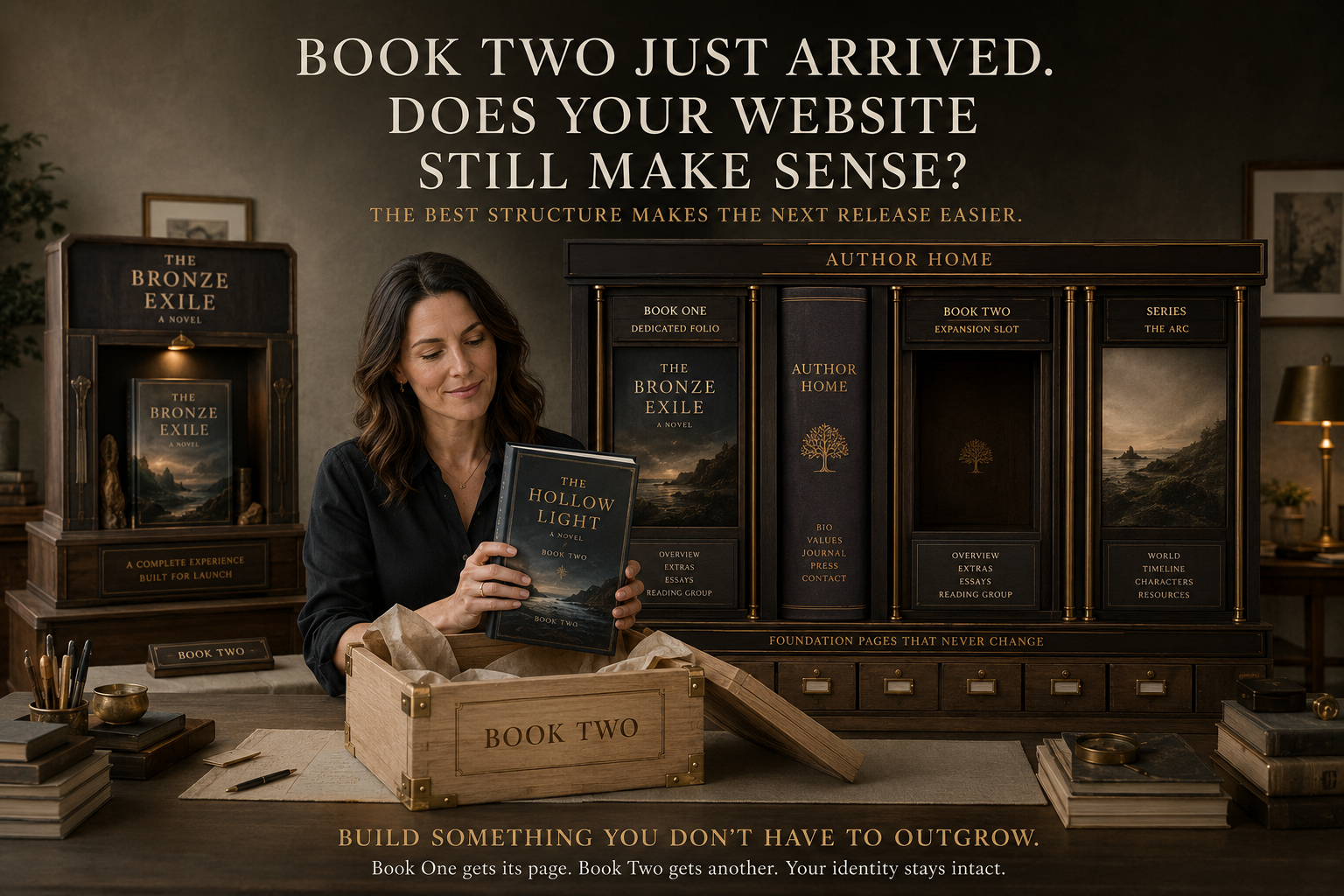
That is what a long-term website structure should do: make the next release easier rather than force another identity decision.
Where Does Professional Author Website Design Fit?
Knowing that you probably need one central author site does not automatically tell you how that site should work.
Reader flow still matters.
So do genre signals, book hierarchy, page structure, mobile experience, content organization, future titles, and the way your website connects with the wider publishing plan.
Montlake Publishers' author website design services are currently structured around the author's genre, voice, book catalog, audience, goals, individual book presentation, reader paths, and room for future releases.
That is the useful role of professional website support.
Not “make the site bigger.”
Make the website fit the author, the books, and what visitors actually need from it.

When the website is being planned as part of a wider release, book marketing services can also help connect the destination with the larger launch and reader-targeting plan.
Final Thoughts: Build for the Writing Career, Not Just Launch Week
The choice between author website vs book website becomes much easier once you stop asking which one sounds more professional.
Ask what must last.
For most authors who expect to keep publishing, the author or pen name should become the main home. Give every important book a focused page within that home.
Use a landing page when one campaign needs tighter attention.
Build a separate book website only when the title has enough independent purpose, content, or audience to justify maintaining another property.
Most importantly, choose something you can keep alive.
Your website should make your publishing career easier to understand as it grows, not give you another abandoned project to feel guilty about.
Need Help Choosing the Right Website Structure?
You do not need the biggest author website.
You need the right home for the work you are building.
If you want professional help planning the pages, book structure, reader path, and room for future releases, contact Montlake Publishers to discuss what your author website actually needs before development begins.
Frequently Asked Questions
Do I need an author website if I only have one book?
Not necessarily, but one book does not rule out an author website either. If you expect to keep writing, a simple author-centered site can support the current title while leaving room for future books. If this is a one-off project with one immediate goal, a focused book page may be enough.
Should every book have its own website?
Usually not. Give every important book its own page, rather than automatically giving every title a separate domain and full website. Individual pages can carry the cover, description, purchase links, reviews, excerpts, format information, and related resources while keeping the author's wider catalog connected.
Is a book landing page the same as a book website?
No. A landing page usually focuses on one title and one primary action, such as ordering or downloading a sample. A full book website contains a broader set of pages and information around the title or series. Many authors need a landing page without needing another complete website.
Should my domain use my author name or my book title?
Career authors will usually get more long-term flexibility from a domain based on the name they publish under. A book-title domain can still be useful as an easy campaign address and can point directly to the relevant page on the main author website without requiring a second full site.
Can one author website handle several books?
Yes. A well-planned author website can organize several standalone books, one or more series, excerpts, reading order, purchase links, author information, and future releases. The Books area can expand gradually while each title receives a dedicated page rather than forcing readers to sort through one oversized catalog.
When is a separate book website worth creating?
Build one when the title has a lasting job that would be difficult to perform inside the main author site. That might include a large resource library, teaching program, independent series identity, educational initiative, collaborative project, or a clearly separate audience that needs substantially different content.
What if I write under different pen names?
Separate sites may make sense when those pen names represent deliberately different reader identities and you do not want the audiences blended. When the names are openly connected and the readership overlaps, one carefully organized property may still work. Let reader expectations and long-term publishing plans drive the choice.
What should an individual book page include?
Start with the cover, a strong hook, description, available formats, clear purchase paths, and relevant proof such as legitimate reviews or endorsements. Add an excerpt, reading-order information, discussion material, event information, or other resources when they genuinely help someone understand, buy, read, or use the book.
Can I use my existing professional website instead of creating an author site?
Yes, when the book closely supports the same expertise, business, and audience. Add a proper book page or Books section rather than duplicating everything elsewhere. When your writing has a very different audience, identity, or future direction, separating the author brand may produce a clearer experience.